
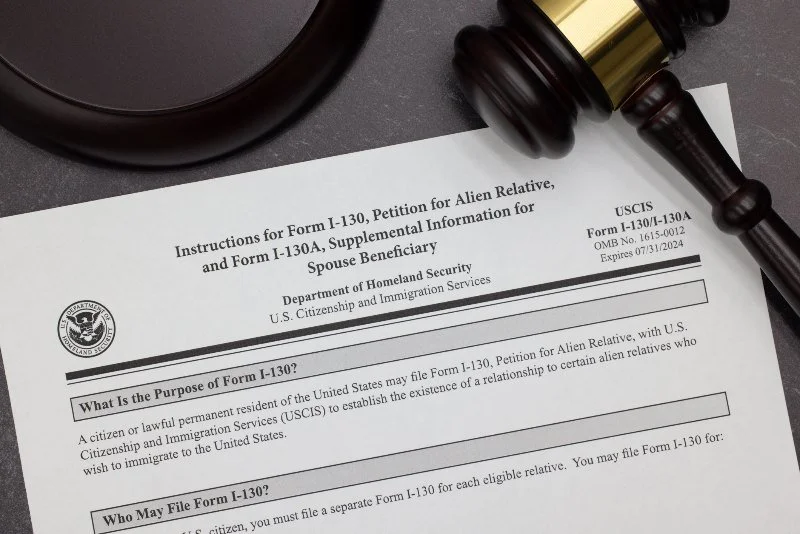
The 1-130 filing fee is $625 for online filings and $675 for paper filings. This fee only covers the petition to establish the qualifying family relationship. The total cost of the Green Card process depends on whether the applicant applies from within the United States or through a U.S. consulate.
To estimate your costs accurately, you need to know which forms are required and when they can be filed. Eligible applicants can submit the I-130 petition and Green Card application together without waiting for the petition to be approved first.
The Difference Between Form I-130 and Form 1-485
These two forms serve different purposes:
Form I-130 is the petition a U.S. citizen or Green Card holder files to establish a qualifying family relationship with an eligible relative.
Form 1-485 is the adjustment of status application that an eligible person already in the United States files to apply for permanent residence.
1-130 approval confirms a qualifying family relationship for immigration purposes. It does not, by itself, grant a Green Card or a work permit. If the family member lives abroad, the permanent residence process generally continues through an immigrant visa application instead of Form 1-485.
Can I-130 and 1-485 Be Filed at the Same Time?
Yes. Eligible applicants can submit both forms together. USCIS calls this “concurrent filing.” To qualify, the person applying for a Green Card must be physically present in the United States, meet the adjustment of status requirements, and be eligible to file under their immigration category at that time.
Who Can File Both Forms Together?
A common example is a U.S. citizen’s spouse applying from within the United States. U.S. citizens’ unmarried children under 21 and the parents of U.S. citizens who are at least 21 also fall under the “immediate relative” category. This category has no annual limit on the number of immigrant visas. Both forms can be filed together if the other eligibility requirements are met.
For family preference categories, such as spouses of Green Card holders, applicants must check the Visa Bulletin chart USCIS accepts for that month. Different filing rules apply to spouses of U.S. citizens and spouses of Green Card holders.
Being in the United States or being married is not enough on its own. How the applicant entered the country, their current immigration status, and any past immigration issues can also affect 1-485 eligibility.
What Is the Benefit of Filing Both Forms Together?
The main benefit is that you do not have to wait for an I-130 decision before filing Form I-485. This allows the Green Card application to be processed while USCIS reviews the family petition. It may reduce the extra waiting time involved in filing the forms one after the other, but it does not guarantee approval or a decision by a specific date.
Eligible 1-485 applicants may also:
Apply for a work permit using Form 1-765.
Apply for an advance parole travel document using Form I-131.
These applications can be reviewed while the Green Card application is pending. Filing them does not automatically authorize employment or travel. Applicants should wait for the required approvals before relying on these applications to work or travel.
If Form I-130 has already been filed, applicants who become eligible may submit Form 1-485 without waiting for I-130 approval. Concurrent filing of 1-130 and 1-485 is not available to applicants completing consular processing from abroad.
How Much Does It Cost to File Both Forms Together?
Filing both forms together does not reduce the filing fees. Each form has a separate fee. The table below shows the standard fees for one applicant aged 14 or older submitting a new filing package by mail:
| Form or Filing | Government Filing Fee |
|---|---|
| Form I-130 family petition | $675 |
| Form I-485 Green Card application | $1,440 |
| Total for both forms | $2,115 |
| Eligible Form I-765 work permit application, if requested | $260 |
| Standard Form I-131 advance parole application, if requested | $630 |
| Total if all four forms are filed | $3,005 |
The $260 1-765 fee applies to eligible applications based on a Form 1-485 filed on or after April 1, 2024, with the required filing fee paid. Different fees may apply to children and certain categories. These totals do not include medical examination costs or attorney fees.
For applicants eligible to file Form I-485 online, the standard fee is $1,390. The rules on who can file online and how the filing must be completed should also be checked. USCIS allows legal representatives to file Forms I-130 and I-485 together online. Applicants filing without a legal representative cannot use the same online filing process.
Costs for Family-Based Consular Processing
When a family member lives in Türkiye or another country, the case generally moves through the National Visa Center (NVC) and a U.S. consulate after the 1-130 stage. A standard family-based case may involve the following additional government fees:
| Fee | Amount |
|---|---|
| Immigrant visa application fee | $325 per person |
| NVC Affidavit of Support review fee | $120, when applicable |
| USCIS Immigrant Fee | $235 per person, unless exempt |
For a case involving one applicant where all of these fees apply, total government fees, including Form I-130, are $1,305 with an online I-130 filing or $1,355 with a paper 1-130 filing. Medical exams, vaccinations, translations, document fees, travel expenses, and attorney fees are additional.
NVC’s $120 review fee is not charged per person. A single fee may apply to related spouse and child cases under certain conditions. Payments are also made at different stages of the process, so the full amount is not due when Form I-130 is filed.
Does Each Family Member Need a Separate I-130?
The answer depends on the family relationship and immigration category. For example, separate 1-130 petitions are required for a mother and father. A petition filed for a U.S. citizen’s spouse does not automatically include the spouse’s child. The child’s eligibility and whether a separate petition is needed must be reviewed.
In some family preference categories, a spouse or child may be eligible to apply through the principal applicant’s case. Before estimating costs, determine how many petitions your family needs. Simply multiplying the 1-130 fee by the number of family members could lead to an inaccurate budget.
What Should You Know Before Paying the Fees?
Under current USCIS rules, electronic payment methods are generally required for filings submitted by mail, with certain exceptions. Form G-1450 is used for card payments, and Form G-1650 is used for ACH payments from a U.S. bank account. Form G-1651 is used to request an exception allowing payment by a paper method; it does not waive the filing fee.
NVC fees are paid through the Consular Electronic Application Center (CEAC) using a U.S. bank account. USCIS and NVC have different payment methods.
An incorrect fee or a payment that cannot be processed may cause a filing to be rejected before it is accepted. Once a filing has been accepted, fees are generally not refunded if the case is later denied or withdrawn. Before paying, check the current fee, filing method, and account details.
Frequently Asked Questions About Filing Fees
Is There a Separate Fee for Form I-130A?
No. USCIS does not charge a separate filing fee for Form I-130A, which is submitted with Form 1-130 for a spouse.
Can I Get an I-130 Fee Waiver Because of Low Income?
A standard I-130 petition does not qualify for the general Form I-912 fee waiver based solely on low income. Special rules for certain humanitarian protection categories may need to be reviewed separately.
Can I Pay Extra to Get a Faster I-130 Decision?
USCIS does not offer paid premium processing for Form I-130. An expedite request may be considered when certain conditions are met, but it is a separate process.
How Can MC Law Firm Help With Your Family Immigration Case?
The right filing plan starts with identifying which family members need a petition and when Form 1-485 can be filed. Waiting unnecessarily when concurrent filing is available, or filing before you are eligible, can affect your timeline and costs.
At MC Law Firm, we review your family relationship and immigration history to assess your filing options. We provide legal support with 1-130 petitions, Green Card applications through adjustment of status, and consular processing.
For a free initial evaluation of your family immigration case, please contact us by phone or email. Feel free to share which family member you plan to petition for, whether the person filing is a U.S. citizen or Green Card holder, and the country where your family member currently lives.
