
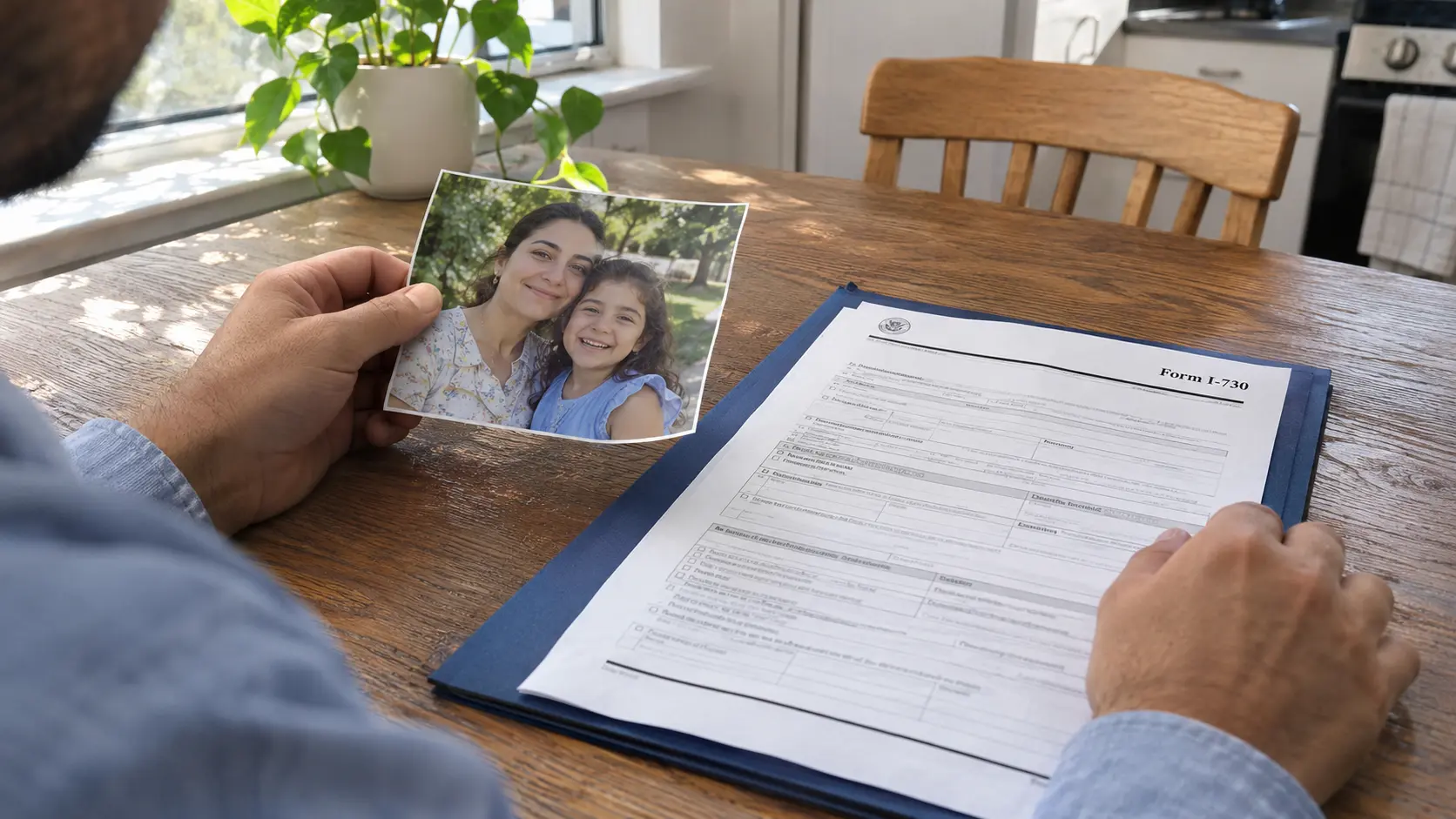
If your asylum application in the United States has been approved, you can start the family reunification process for your spouse and children without waiting for a Green Card. With Form I-730, you can file an I-730 petition so that a family member abroad can join you, or so that a spouse or child already in the United States can benefit from your asylum status.
Two dates are especially important when preparing your I-730 petition. The date you filed your asylum application may affect how your child’s age is calculated. The date your asylum was approved starts the two-year filing deadline for the I-730 petition.
Who Can File an I-730 Petition?
An I-730 petition can be filed by the person whose own asylum claim was approved. If your asylum case is still pending, a decision must be issued first. If you received asylum status through your spouse or parent, you cannot file an I-730 petition for another family member based on that status.
If you obtained a Green Card after your asylum approval and meet the other requirements, you can still file an I-730 petition for your spouse or child. The date your Green Card was issued does not restart the two-year deadline.
Which Family Members Are Eligible?
If you are filing for your spouse, you must have been legally married on the day your asylum was approved. The marriage must continue throughout the filing and review process and, if your spouse is abroad, until their admission to the United States. If you married after your asylum approval, other family-based immigration options may be available for your spouse depending on your immigration status.
If you are filing for your child, the child’s age, marital status, and when the parent-child relationship was established will be reviewed. Additional documents showing the family relationship may be required for a stepchild, an adopted child, or a child born outside of marriage. A child who was in utero when your asylum was approved and born afterward may also qualify if the requirements are met.
A separate I-730 petition is required for each family member. For example, if you are filing for your spouse and two children, you will prepare three separate forms. Parents and siblings are not eligible under an I-730 petition.
What Happens If Your Child Turned 21 While Waiting?
Suppose your child was 19 when you filed your asylum application and 23 by the time a decision was made. In this case, your child’s current age alone does not prevent family reunification.
Under the Child Status Protection Act (CSPA), your child’s age may be calculated based on the date you filed your Form I-589 asylum application. Your child must be unmarried and meet the other requirements. For this reason, review the birth certificate, your I-589 filing record, and marital status information together.
How Is the Two-Year Filing Deadline Calculated?
As a general rule, you must file the I-730 petition within two years of the date you were granted asylum. For example, if you applied for asylum in 2021 and were approved in 2025, the deadline is calculated from the 2025 approval date. If your asylum was granted in immigration court, also check the date the decision became final.
If two years have passed, USCIS may accept a late filing for humanitarian reasons. To do so, you need to explain what caused the delay and how it prevented you from filing on time. For example, if a serious health condition prevented you from filing, medical records from that period may support your request. USCIS evaluates each request based on the circumstances of the case.
What Documents Are Required for an I-730 Petition?
The documents you need depend on who you are filing for. The main documents include:
- Asylum and identity records. Your asylum approval notice or court decision, identity documents, your family member’s passport information, and a recent photo as required.
- Proof of relationship for your spouse. Your marriage certificate and, if applicable, records showing that any prior marriages were legally terminated.
- Proof of relationship for your child. A birth certificate and, depending on your situation, additional records showing adoption, a stepchild relationship, or the parent-child relationship.
- Other supporting records. Name change documents if any, current address and contact information, and entry and immigration records if your family member is in the United States. Documents not in English require a complete English translation and the translator’s certification of competence and accuracy.
If you cannot obtain an official birth or marriage certificate, explain why the document is unavailable. Depending on the situation, school records or written statements from people with direct knowledge of the family relationship may help.
Also review the family information in your original asylum application. If your spouse’s or child’s name is missing from your I-589, or if names and dates differ between documents, it is important to explain the reason and show when the family relationship was established.
What Happens After You File?
- USCIS accepts the petition. After an initial review of the form, USCIS sends a receipt notice. This notice includes the number you can use to track your case. Your family member’s eligibility is evaluated later. If USCIS needs additional evidence, it will notify you separately of what it needs and the response deadline.
- The case is routed based on where your family member is located. If your family member is in the United States, the USCIS field office with jurisdiction may handle the interview and decision. If they are abroad, after initial processing in the United States, the case may be sent through the National Visa Center (NVC) to the appropriate USCIS international office, U.S. Embassy, or consulate. Processing abroad may continue even after you receive an approval notice from USCIS.
- Your family member prepares for the interview. The responsible office will provide the appointment location and the documents to bring. Identity and the family relationship are verified at the interview. For cases abroad, follow the appointment letter sent to your family member regarding the medical examination and original documents.
- A travel document is issued for the family member abroad. Once the interview and required checks are completed, the responsible office will provide travel instructions. When your family member receives the document, they should check the information and expiration date on it before planning their trip.
What Can You Do If the Wait Gets Longer?
The wait after an I-730 petition can take years. Review in the United States, the interview queue abroad, and post-interview checks may each take time. For this reason, the processing times published by USCIS alone do not show when your spouse or child will be able to travel.
When requesting information about your case, contact the office named in the most recent transfer or appointment notice. If your family member moves or relocates to another country, notify the office handling the case of the new address. If there is a change affecting the family relationship, such as a divorce or your child’s marriage, also assess its impact on the I-730 petition.
If there is an urgent medical or safety risk, you can request expedited processing of your case. For example, records showing threats your spouse has received or a doctor’s report explaining your child’s serious medical condition can demonstrate why you cannot wait. If the request is approved, your case may be reviewed ahead of its normal place in line. The required checks are still completed before a decision on the I-730 petition can be made.
Let’s Review Your I-730 Petition Together
If your asylum has been approved and you are planning family reunification for your spouse or child, the first step in an I-730 petition is determining which family members are eligible and how much time you have left.
At MC Law Firm, we review your asylum decision and the documents showing your family relationship, and we plan the steps your case requires, from preparing the petition to the interview.
Complete the form below to contact us for a free case assessment.
Phone: 201-957-0909
Email: [email protected]
