
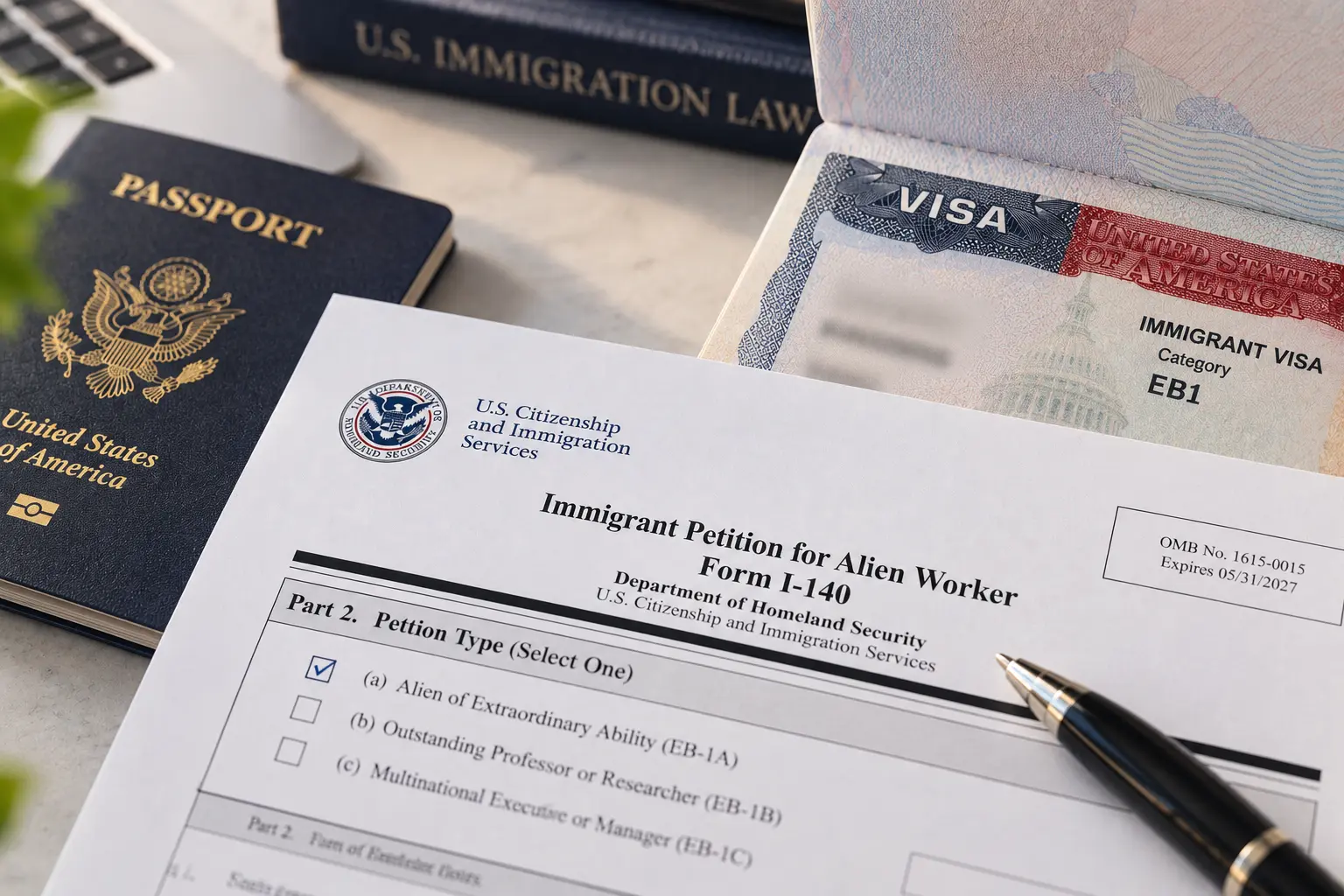
The EB-1 category is one of the fastest ways to get a Green Card in the United States.
It can be attractive because some applicants may move forwardwithout a job offer, without the PERM labor certification process, and without a long visa wait. At the same time, EB-1 has one of the highest standards, and USCIS review has become stricter in recent years.
This guide explains the three EB-1 subcategories, how USCIS actually reviews these cases, what has changed in 2026, and how the Visa Bulletin can affect applicants based on country of birth.
What Is EB-1?
EB-1 is the first employment-based Green Card category. It has three main subcategories:
| Category | Who it is for | Is a sponsor required? |
|---|---|---|
| EB-1A | People with extraordinary ability in science, art, education, business, or sports | No - you can file for yourself |
| EB-1B | Outstanding professors and researchers | Yes - a university or research institution |
| EB-1C | Multinational managers and executives | Yes - a related U.S. company |
What makes EB-1A different is the self-petition option. You can file your own petition without needing a job offer. Among the EB-1 subcategories, this option exists only for EB-1A. All EB-1 categories are also exempt from PERM labor certification. That alone can save 1 to 2 years in many cases.
Why the Visa Bulletin Matters
According to the September 2026 Visa Bulletin, EB-1 is current for all countries except China, with a cutoff date of July 1, 2023, and India, with a cutoff date of October 15, 2022. This has an important practical effect: if your country of birth is not China or India, you may not have to wait for a priority date to become current. Applicants born in China or India may still face years of waiting, even in the EB-1 category.
If you are in the United States with lawful status, you may be able to file Form I-140, the immigrant petition, and Form I-485, the adjustment of status application, at the same time. This is known as concurrent filing. It may also allow you to apply for work authorization (EAD) and Advance Parole while you wait.
Important note: The Department of State regularly reminds applicants that categories can move backward or become unavailable when annual visa limits are reached near the end of the fiscal year. The fiscal year ends on September 30, so the chart can change again in October. Always check the latest Visa Bulletin before planning your case.
EB-1A: Is Meeting 3 of the 10 Criteria Enough?
On paper, the rule looks simple. You either have a major one-time international award, such as a Nobel Prize, Oscar, or Olympic medal, or you meet at least 3 of the 10 USCIS criteria:
Nationally or internationally recognized awards
Membership in associations that require outstanding achievement
Published material about you or your work
Judging the work of others, such as peer review or jury work
Original and important contributions to your field
Scholarly or academic articles
Art exhibitions or showcases
A leading or critical role for respected organizations
A salary that is clearly higher than the average in your field
Commercial success in the performing arts
Community data shows that the most common criteria are judging, original contributions, published material, critical role, high salary, and academic publications. Many strong cases do not rely on only 3 criteria. They often claim 4 or 5.
Helpful Flexibility in USCIS Guidance
Current USCIS policy guidance gives applicants a little more room in some areas:
Team awards can count. If an award was given to a team, you may still be able to use it. You need to show your own role in the team success and explain why the award is important at a national or international level. This can be helpful in research, sports, and the arts.
Past memberships can also count. For the membership criterion, USCIS may consider past memberships, not only memberships you currently hold.
The published material criterion has become more flexible. USCIS has expanded the ways applicants can show that media or published content demonstrates recognition.
The Main Issue: Final Merits Determination
Many applicants think, “I met 3 criteria, so my case is done.” That is not how EB-1A works. USCIS uses a two-step review that comes from the Kazarian decision:
Step one – Threshold review: Do the documents technically meet the listed criteria?
Step two – Final merits review: Looking at all the evidence together, does this person truly stand at the top of the field?
A case can pass the first step and still be denied at the second step. In 2026, many denials happen at this stage. According to former USCIS officers, the drop in approvals does not seem to come from a formal rule change. Instead, officers appear more willing to deny cases during this more subjective final review.
A typical case that struggles at this stage may have strong citation numbers, a high salary, and a leadership role at a startup. Each item may meet a criterion by itself. But if the petition does not explain why these facts together show that the person is at the top of the field, the final merits review can still be negative.
Another key concept is sustained recognition. USCIS does not set an exact time requirement, but officers look for continued activity. If an applicant had a major success 10 years ago and nothing new since then, USCIS may see that as a weakness.
For comparison, EB-1A requires you to show that you are at the top of your field. EB-2 NIW usually requires a lower level: that you are clearly above the average in your field. This difference should be your starting point when choosing between the two categories.
The Kazarian Test Is Being Challenged
In April 2026, a federal court in Nebraska found that USCIS acted in an arbitrary and capricious way when it denied an EB-1A case. The court also questioned the legality of the two-step Kazarian framework. The Department of Justice appealed the decision to the Eighth Circuit Court of Appeals. While the case continues, USCIS is still using the current two-step process.
If you are preparing an EB-1A case today, you should build it to pass the final merits review. This lawsuit may affect the review standard in the future, so it is worth following.
Processing Times and Cost
Standard processing time: In 2026, processing is usually around 6 to 19 months. The timing can change a lot depending on the service center and case volume.
Premium processing: For an extra fee, USCIS gives a response within 15 business days. It is available for EB-1A and EB-1B. Premium processing is not an approval guarantee. It only guarantees speed. If the case is weak or incomplete, you may simply receive an RFE within 15 business days.
RFE warning: USCIS can now set RFE response deadlines shorter than the old standard 12 weeks. It also removed the extra 14 days that used to apply to notices sent outside the United States. If you need documents from another country, this can directly affect you. It is more important than ever to submit a complete case from the beginning.
6 Practical Ways to Strengthen Your Case
Document fewer criteria deeply instead of many criteria weakly. Two well-supported criteria can be stronger than five weak ones with thin evidence.
Assume the officer does not know your field. The person reviewing your case is probably not an expert in your area. For each important exhibit, explain what it is, why it matters in your field, and which EB-1A requirement it supports.
Show prestige with numbers. If you use an award, explain how many people applied and how many won. If you use membership, document the admission standards. If you use a leadership role, connect your work to measurable results.
Prioritize independent recommendation letters. Letters from people who know your work independently usually carry more weight than letters from your employer or co-authors. General praise is not very useful. Specific and verifiable achievements matter much more.
Build a clear story. Do not submit only a pile of documents. Present an argument. For example: I solved this problem in my field, the solution was used or recognized in this way, and that is why I am one of the leading people in my area.
Show continued recognition. Add recent evidence from the last 2 to 3 years, such as new achievements, publications, invitations, awards, or recognition.
EB-1A or EB-2 NIW?
This is one of the most common questions for academics, researchers, entrepreneurs, and professionals. The short answer is: if your case is borderline and you are not sure it can pass the final merits review, EB-2 NIW may be more realistic because the standard is lower.
Your country of birth can also affect the strategy. If EB-2 is current for most countries, applicants who were not born in China or India may not feel the same pressure to choose EB-1. That gives them more flexibility when choosing a category.
Some applicants file both cases. This increases the cost, but it can create two separate chances.
Common Mistakes
Using template recommendation letters. Officers can usually tell when several letters came from the same template.
Treating citation numbers as enough by themselves. Citations matter, but they need context. You should compare them with the normal citation levels in your field.
Stopping after meeting the criteria. Cases that ignore the final merits review are often denied.
Listing publications without explaining their impact. Where something was published matters, but what it changed matters more.
Defining the field too broadly. Do not simply say “software”. A more specific field, such as “fault tolerance in distributed systems,” is easier to explain and prove. To show that you are at the top, the field must have clear boundaries.
Conclusion
EB-1 is not impossible, but the standard is much higher in 2026. For applicants outside China and India, a current EB-1 category can be a major advantage. Most denials do not happen only because a criterion is missing. They happen because the full case does not clearly show that the person is at the top of the field. Before collecting documents, build the story of your case. Then collect the documents that support that story, not the other way around.
How Can MC Law Firm Help?
At MC Law Firm, we provide strategic guidance throughout every stage of the EB-1 process, helping you navigate USCIS’s strict requirements and the two-step Kazarian analysis. We carefully evaluate and prepare your case to build a strong, complete petition and reduce the risk of receiving a Request for Evidence (RFE).
We also help you make effective use of important opportunities such as Visa Bulletin updates and concurrent filing. From developing strong independent recommendation letters to building a persuasive case narrative, every part of the petition is structured to show, through clear and concrete evidence, that you have reached the top of your field.
Contact
201-957-0909
[email protected]
Follow Us
Instagram: @allthingsimmigration
