
What is PERM?
PERM is an important certification step used in the employer-sponsored Green Card process in the U.S., where the employer tests the labor market. This process is overseen by the U.S. Department of Labor. It involves the employer proving that they could not find a qualified U.S. worker for the position, thereby requesting approval for their own foreign candidate.
PERM is mainly relevant for employment-based Green Card categories like EB-2 and EB-3. In this process, the employer aims to show they wish to employ the foreign worker permanently and that this employment will not negatively affect the wages or working conditions of U.S. workers.
The PERM process is a technical one that requires careful planning by both the employer and the employee. Preparing job descriptions, posting the necessary ads, evaluating applications, and accurately preparing the information to be submitted to the Department of Labor are of great importance.
Who Needs PERM?
The PERM process is important for employers who want to file an employer-sponsored Green Card application for a foreign worker in the U.S.. It is generally used by employers who want to support a foreign worker for permanent employment.
The PERM process usually comes up for the following groups:
Skilled workers: Those with at least two years of training or experience.
Professionals: Those who hold a bachelor’s degree.
Other workers: Those working in positions requiring less than two years of experience or training.
The employer must show that there are no qualified U.S. workers for the position and that hiring a foreign worker will not negatively impact the wages or working conditions of U.S. workers.
Basic Requirements for PERM
For a PERM application, both the employer and the foreign worker must meet certain requirements.
Employer Requirements
The employer must prove they could not fill the open position with the U.S. workforce. Therefore, the position must be real, permanent, and linked to the employer’s business needs. The employer must also conduct a correct and sufficient search of the local workforce. This process includes steps such as advertisements, application reviews, candidate evaluations, and recruitment records.
Additionally, the employer must show that the offered wage is in line with the prevailing wage level determined for the position. During the PERM process, the job description, position requirements, and wage level must be consistent with each other.
Foreign Worker Requirements
The foreign worker must possess the education, experience, and qualifications required for the position defined by the employer.
The worker’s past education, work experience, and professional qualifications must match the position requirements specified in the PERM process. Therefore, the worker’s resume, diplomas, certificates, and experience documents are important for the filing strategy.
PERM Application for EB-2 and EB-3
The PERM process applies to employer-sponsored EB-2 and EB-3 Green Card applications.
EB-2 is an employment-based Green Card category for professionals holding advanced degrees or individuals with special expertise in their field.
EB-3 is an employment-based Green Card category for professionals, skilled workers, and certain other employees.
EB-3 is divided into three sub-categories:
Professionals: Individuals working in positions that require at least a bachelor’s degree.
Skilled Workers: Individuals working in jobs that require at least 2 years of training, experience, or expertise.
Other Workers (Unskilled Workers): Individuals working in positions that require less than 2 years of training or experience.
In practice, many people come to the U.S. with temporary statuses such as F-1, J-1, H-1B, L-1, O-1, or E-2, and then can begin the PERM process under EB-2 or EB-3 through appropriate employer sponsorship.
Filing from Inside or Outside the U.S.
While whether the applicant is inside or outside the U.S. does not change how the PERM process works, it is important for maintaining status and obtaining a Green Card.
For those in the U.S., finding a sponsor alone is not enough; the individual must maintain their legal status while the Green Card process moves forward. Since the PERM, I-140, and visa bulletin processes can take time, it is critical for the person in the U.S. to maintain their current status and not violate it. This is especially sensitive for F-1 students because the PERM process can take a long time. Factors such as F-1 status, school enrollment, OPT, STEM OPT, work authorization, and potential transitions to other statuses must be carefully evaluated.
For those outside the U.S., the process moves forward through consular processing, depending on the visa bulletin and consular stages.
Does a PERM Application Grant Work Authorization?
Filing a PERM application does not automatically give a foreign worker permission to work.
To work legally in the U.S., the individual must have a valid status or permit that allows them to work. For example, if someone is on H-1B status, they can work for the authorized employer. F-1 students can only work under specific permissions like OPT, STEM OPT, or on-campus work. Therefore, PERM does not provide work authorization on its own; work rights must be evaluated separately.
Family Members
The PERM application is primarily between the foreign worker and the employer. However, when the main applicant’s Green Card process moves forward, eligible family members (spouse and unmarried children under 21) can be included as derivative applicants.
How the PERM Process Works
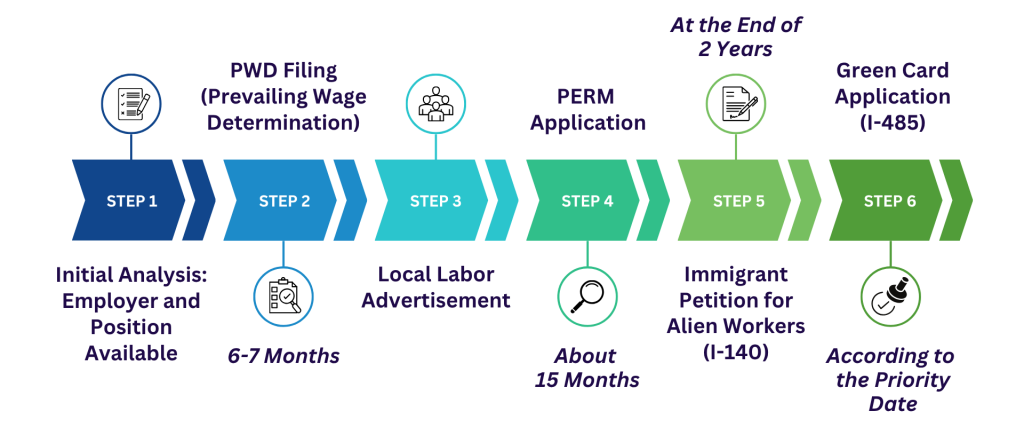
- Employer Determines Need: The employer identifies a permanent position that needs to be filled and prepares to show it cannot be filled by the local workforce.
Defining the Job: The required education, experience, and skills are clearly defined. This forms the basis of the entire process.
Recruiting the Local Workforce: The employer must advertise the position to the U.S. workforce. This includes steps like internal notices, State Workforce Agency postings, and newspaper ads. Professional positions may require additional methods like job fairs, company websites, or trade organizations.
Reviewing Applications: The employer reviews applications to see if any qualified U.S. workers applied. If a qualified and available U.S. worker is found, the process may stop. If not, the employer can continue.
Preparing and Submitting the Application: Once the search is done, the employer submits Form ETA-9089 to the Department of Labor.
Department of Labor Review: The Department of Labor reviews the application. If it is complete and correct, it is expected to be approved, though some cases may be selected for an audit.
PERM Approval: Once approved, the employer and employee move to the next major step, which is the I-140 petition.
After PERM: I-140 Petition and Green Card
After PERM approval, the employer submits the I-140 petition to U.S. Citizenship and Immigration Services (USCIS). This petition confirms the employer’s ability to pay and the worker’s qualifications.
Once I-140 is filed or approved, the timing of the final Green Card application depends on the “visa bulletin” and the applicant’s “priority date”. If the priority date is current, some individuals in the U.S. may be able to file for the final adjustment of status (I-485) at the same time as the I-140, which is called “concurrent filing”. If not, the applicant must wait for their turn according to the visa bulletin.
How Can MC Law Firm Help You?
Every case may have different risks and strengths. Therefore, evaluating both the employer and the worker’s situation in detail before starting the PERM process, and ensuring the process is followed in the correct order and with care, is of great importance.
As MC Law Firm, we provide legal support to applicants and employers in employer-sponsored Green Card applications, the PERM process, determining EB-2 and EB-3 strategies, I-140 and I-485 stages, visa bulletin tracking, and consular processes.
Contact us.
201-957-0909
[email protected]
Instagram: @allthingsimmigration
