
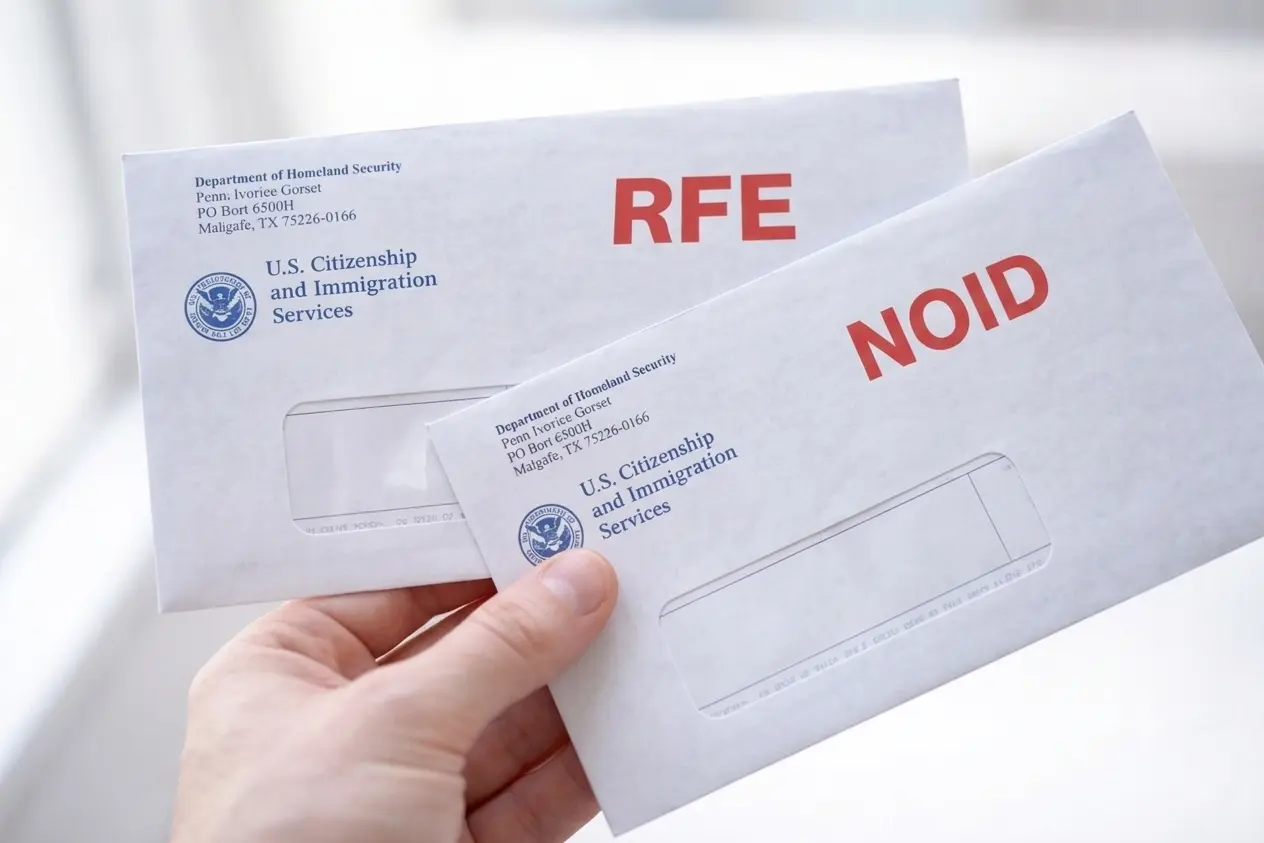
If you have applied for a US visa, Green Card, or work permit and spotted a thick envelope from USCIS (US Citizenship and Immigration Services) in your mailbox, your heart probably skipped a beat.
The document inside that envelope is most likely one of two things:
RFE (Request for Evidence) or
NOID (Notice of Intent to Deny).
Both carry crucial updates about your application, but knowing the difference between them can completely change your strategy. In this guide, we will break down both notices, highlight their key differences, explore recent policy updates, and provide a step-by-step response strategy.
What Is an RFE (Request for Evidence)?
An RFE is an official request showing that the USCIS officer reviewing your case needs extra information or documentation before making a final decision. Sent as Form I-797E (Notice of Action), it means your application cannot be approved just yet, but it has not been denied.
Think of it this way: The officer looked at your file and thought, “Something is missing or not strong enough here, but you still have a chance. Complete this, and I will re-evaluate.” In short, an RFE is an opportunity to prove your case.
When Does USCIS Send an RFE?
According to the USCIS Policy Manual, an officer issues an RFE when:
The initial documents fail to fully prove you meet the eligibility rules.
A required form or document is missing (e.g., birth certificate, marriage certificate, diploma).
The submitted evidence does not sufficiently support a specific requirement.
The employer-employee relationship needs clarification (especially in H-1B work visas).
Financial stability or the authenticity of a relationship needs further proof (in family-based applications).
What Is Included in an RFE?
A typical RFE notice consists of these sections:
The Facts: Basic details such as your application type, date, and processing office.
The Law: The specific immigration laws and regulations applying to your case.
Evidence Submitted: A list of the documents you already sent.
Evidence Lacking: What exactly USCIS needs to make a decision—this is the most critical part.
RFE Response Deadline
The maximum response time for an RFE is 84 days (12 weeks). USCIS adds 3 extra days for mailing if you are inside the US, and 14 days if you are abroad. No extensions are granted. Your response must physically reach USCIS by the deadline—simply dropping it in the mail on the last day is not enough.
What Is a NOID (Notice of Intent to Deny)?
A NOID is much more serious than an RFE. It means the USCIS officer has reviewed your file and concluded that your application does not meet the requirements. They are stating their intention to deny your case, but are giving you one last chance to challenge their decision before it becomes official.
To use a traffic light analogy: An RFE is a yellow light warning you to proceed with caution. A NOID is a blinking red light signaling a major problem that requires immediate action.
When Does USCIS Send a NOID?
USCIS issues a NOID when:
The applicant clearly fails to meet basic eligibility rules.
There are serious doubts about the authenticity of a marriage (in family cases).
Significant contradictions or inconsistencies are found in your paperwork.
There is a suspicion of fraud or misrepresentation.
Negative information comes to light that you might not know about (criminal record, past visa violations, etc.).
For H-1B visas, the position is judged not to qualify as a “specialty occupation”.
A random workplace site visit yields negative findings.
NOID Response Deadline
The response window for a NOID is usually just 30 days (plus 3 days for domestic mailing or 14 days for international mailing). This timeline is much shorter than an RFE, making fast, strategic action absolutely necessary.
Key Differences Between RFE and NOID
| Feature | RFE | NOID |
|---|---|---|
| Severity Level | Moderate – requesting missing details | High – last chance before a formal denial |
| Officer's Stance | "I can't decide yet; I need more proof." | "I plan to deny this; change my mind." |
| Response Window | 84 days (+ mailing time) | 30 days (+ mailing time) |
| Response Strategy | Supplying the missing documents | Building legal arguments + powerful new evidence |
| Approval Odds | High (approx. 80-85% approval with a solid reply) | Low to Moderate (requires an airtight response) |
| Need for an Attorney | Recommended | Strongly recommended |
2025-2026 Update: Increased Scrutiny and Policy Shifts
The immigration landscape has seen significant changes over the 2025–2026 period. Staying informed on these trends is vital for your application strategy.
Rising RFE and NOID Rates
Starting in 2025, USCIS began issuing far more RFEs and NOIDs, particularly for employment-based visas like O-1, L-1, EB-1, and EB-2 NIW. Immigration lawyers report that requests are both more frequent and much broader in scope, driven by changing agency priorities and staffing shifts. For instance, H-1B visa RFE rates for extensions and transfers have jumped from around 9% to over 30%, matching intense scrutiny levels not seen since 2019.
Growing Pressure on EB-2 NIW and EB-1A
The most notable trend in 2025–2026 is the strict review of “National Importance” claims for EB-2 National Interest Waiver (NIW) applications. Officers now expect:
Detailed documentation showing how the applicant’s work differs from standard industry practices.
Specific evidence regarding the methodology of the proposed endeavor, not just the potential final results.
Independent verification, such as citations, commercial implementation, or widespread adoption metrics.
While EB-2 NIW cases were historically considered easier to pass than EB-1A, by 2026, the trend reversed, pushing EB-2 NIW denial rates above those of EB-1A.
Recent Policy Updates (2025)
January 2025 Update: USCIS updated its Policy Manual for EB-2 NIW, clarifying that entrepreneurial ventures do not automatically qualify as having “national importance,” raising the bar for startup founders.
August 2025 Update: For family-based applications, a major change allows officers to issue an outright denial without sending an RFE or NOID first if basic initial evidence is missing. This makes submitting a flawless initial package essential.
AI-Powered Screening
By 2026, USCIS fully integrated artificial intelligence tools to cross-reference data across multiple applications. Discrepancies between your current application and past tourist or student visa filings are caught much faster now.
What to Do If You Get an RFE
Don’t panic. An RFE is not a rejection. Roughly 85% of H-1B applications that face an RFE are still approved after a correct response.
Track the deadline. Immediately mark the final date on your calendar. The clock starts ticking from the date printed on the notice, not the day it arrives in your hands.
Analyze every point. Break down the “Evidence Lacking” section and make a checklist of every single item requested.
Send everything at once. USCIS will treat partial responses as an invitation to make a final decision on whatever you sent. You do not get a second chance to mail remaining documents.
Draft a clear cover letter. Organize your response package with a cover letter that directly matches each piece of new evidence to the corresponding USCIS request.
Use trackable mail. Always use a delivery method that gives you proof of receipt at the USCIS office.
Consult an immigration attorney. Getting professional help—especially for work visas—significantly improves your success rate.
What to Do If You Get a NOID
Act immediately. The 30-day window passes incredibly fast. Contact an immigration lawyer within the first 24 to 48 hours.
Deconstruct the reasons for denial. A NOID lays out the exact reasons why the officer wants to reject your case. You must address every single objection.
Provide legal arguments, not just papers. Responding to a NOID requires more than just sending a missing certificate. You must build a legal argument, reframe existing evidence, and often submit fresh expert opinion letters to change the officer’s mind.
Submit a single, comprehensive response. Just like an RFE, your reply must be complete and sent all at once.
Consider withdrawing. In rare cases, it might be safer to withdraw the application before a formal denial is issued, allowing you to strengthen your file and re-apply later. Discuss this strategy carefully with your lawyer.
What Happens If You Ignore the Notice?
The rule is identical for both RFEs and NOIDs: if you fail to respond within the given timeframe, USCIS will rule based on the existing file. This almost always results in a formal denial.
Frequently Asked Questions (FAQ)
Does getting an RFE mean my application will be denied?
No. RFEs are standard parts of the process. Most applicants who provide a clear, accurate response get their approval.
Can I turn a NOID into an approval?
Yes, but it is challenging. It requires an intense, legally grounded response, making professional legal help vital.
Does Premium Processing prevent getting an RFE?
No. Premium processing only speeds up the review timeline; it has no impact on the officer’s decision to issue an RFE or NOID. However, once you submit your RFE response, USCIS must issue a decision within 15 business days if premium processing is active.
Can I get both an RFE and a NOID on the same case?
Yes. USCIS can issue an RFE first. If your response does not fully satisfy them, they may follow up with a NOID before making a final decision.
What if I send a partial response to an RFE?
USCIS will proceed to judge your case using only the partial information provided. They will not send a reminder or a second RFE.
Summary
RFEs and NOIDs are major milestones in your US immigration journey. Recognizing the difference between them enables you to execute the right strategy at the right time.
Given the tighter review standards of 2025–2026, building a thorough and flawless application package from day one is your best defense. Remember: an RFE is an opportunity to clarify, and a NOID is your final chance to turn things around.
How MC Law Firm Can Help
Navigating an RFE or NOID can be incredibly stressful—but you don’t have to do it alone. At MC Law Firm, we support you through every stage of your immigration journey:
Pre-application strategy: We build your initial file to minimize RFE and NOID risks from the start.
RFE & NOID responses: We carefully analyze your notice, compiling the exact evidence and legal arguments needed to secure an approval.
Up-to-date policy tracking: We continuously adapt our strategies to align with the stricter 2025–2026 USCIS standards.
If you have received an RFE or NOID, time is running out. Contact us today for a free initial evaluation, and let’s secure your path forward.
Contact
201-957-0909
[email protected]
Follow Us
Instagram: @allthingsimmigration
